
What Does the IRS Require in a Real Estate Appraisal?

IRS real estate appraisal requirements depend on the tax purpose. An appraisal supporting an estate tax return, a lifetime gift, or a charitable contribution may involve different rules for valuation dates, appraiser qualifications, report contents, and supporting documentation.
“IRS appraisal” is not one universal product. A report’s title does not establish whether it satisfies the requirements of a particular filing.
The starting point is identifying the transaction, property interest, effective valuation date, and applicable federal rules. The appraisal then needs appropriate research, valuation methodology, and documentation to support its conclusions.
Your CPA, attorney, or tax advisor should identify the filing requirements. The appraiser should understand those requirements before determining the scope of work.
What Is a Qualified Appraisal?
“Qualified appraisal” has a specific meaning under certain federal tax provisions. It should not be used simply as a marketing description for any professionally prepared report.
For noncash charitable contributions, Treasury Regulation § 1.170A-17 establishes requirements covering appraisal preparation, timing, contents, and appraiser eligibility.
Gift-tax adequate-disclosure rules contain their own appraisal provisions under Treasury Regulation § 301.6501(c)-1(f)(3). Those provisions should not be treated as identical to the charitable-contribution rules.
An estate-related valuation must likewise be evaluated under the requirements applicable to that estate matter. Calling a report a “qualified appraisal” does not establish compliance with every federal tax rule.
Three Different Standards to Understand
| Requirement | What it addresses |
| Professional appraisal standards | How the appraisal is developed and reported, including applicable USPAP obligations |
| Federal tax requirements | Tax-specific qualifications, contents, timing, disclosures, and substantiation |
| Assignment requirements | The property, ownership interest, effective date, intended use, and information needed for the particular valuation |
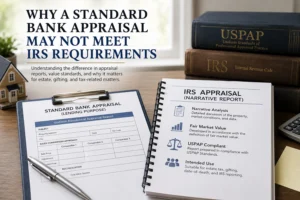
A report may need to address all three. Compliance with professional standards alone does not automatically establish compliance with every tax-specific requirement.
What Is a Qualified Appraiser?
A qualified appraiser must satisfy the requirements of the applicable federal provision—not simply hold a business license or describe themselves as an expert.
For charitable-contribution appraisals, relevant requirements include verifiable education and experience with the property type, regularly performing paid appraisals, and eligibility under the rules excluding certain individuals. The regulation also addresses required declarations.
Gift-tax adequate-disclosure provisions separately address qualifications, experience, independence, and appraisal contents.
Is a State-Certified Appraiser Automatically Federally Qualified?
No. A state credential and federal appraiser eligibility answer different questions.
A state credential establishes a licensing classification and permitted scope of practice. Federal rules may impose additional or different conditions for a particular tax purpose.
When selecting a real estate appraiser, discuss both the property experience and the federal requirements relevant to your assignment.
Why Is the Effective Valuation Date Critical?
The effective date identifies when the opinion of value applies. It is distinct from the inspection date and the report completion date.
A property inspected today can be appraised as of an earlier date when sufficient historical evidence is available.
Different tax purposes involve different dates:
- Estate tax: Property is generally valued as of the date of death unless a permitted alternative applies.
- Lifetime gifts: The relevant valuation generally relates to the date of the completed gift.
- Charitable contributions: Specific rules govern the valuation effective date, appraisal timing, and receipt of the report.
- Estate planning: The date should match the planning question; later transactions may require updated valuations.
The Form 706 instructions explain the general date-of-death rule and alternate valuation election. Your tax advisor should determine whether an alternative is available and appropriate.
Historical Evidence Must Match the Assignment
A retrospective appraisal should analyze market conditions and property characteristics relevant to its effective date.
Current photographs may show renovations completed afterward. Current rents may differ from historical leases. Recent sales may reflect a different market.
The report should explain how the evidence supports the required historical value.
How Should the Property and Property Rights Be Identified?
A useful tax-related appraisal identifies what is being valued with enough detail to distinguish it from another property or interest.
Depending on the assignment, relevant information may include:
- Property address and legal description.
- Assessor’s parcel number.
- Site area and land characteristics.
- Building size, square footage, and improvements.
- Relevant physical condition.
- Ownership interest and property rights.
- Leases, easements, restrictions, or other relevant agreements.
The distinction between the entire property and the interest transferred can be important.
For example, a direct interest in real estate is not automatically equivalent to an ownership interest in an entity that holds the property. The engagement should identify the asset being valued and whether additional valuation expertise is required.
For estate tax reporting, the IRS’s Schedule A instructions require enough real estate detail to locate the property and direct filers to explain how values were determined and attach copies of appraisals.
How Must the Appraisal Support Fair Market Value?
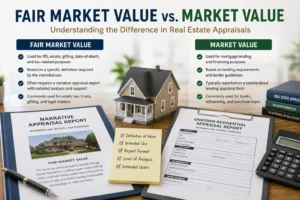
Federal estate and gift valuations generally center on fair market value: a hypothetical exchange between willing, informed parties without compulsion, under the applicable definition.
An asking price, assessed value, insurance figure, or online estimate should not automatically be substituted for that analysis.
The report should identify the applicable value definition and connect its conclusions to relevant evidence.
Our guide to fair market value versus market value explains why the definition and intended use deserve attention.
A Supported Conclusion Requires More Than a Number
A reader should be able to understand:
- Which property interest was valued.
- Which market evidence was considered.
- How significant differences were analyzed.
- Which assumptions affected the conclusion.
- Why the selected methods were appropriate.
The objective is an independent valuation supported by the facts, rather than a value selected to produce a preferred tax result.
What Valuation Methodology Should Be Explained?
The appropriate methods depend on the property, available evidence, and assignment.
Sales Comparison Approach
The sales comparison approach analyzes sales of comparable properties and considers differences affecting value.
For a home appraisal or other residential valuation, relevant characteristics may include location, square footage, condition, quality, site utility, and amenities.
The report should explain significant comparable selection decisions and adjustments.
Income Approach
The income approach may be relevant to rental homes, apartment buildings, commercial properties, and other income-producing real estate.
Analysis may involve market rents, existing leases, vacancy, operating expenses, and market-supported capitalization or discount rates.
Historical assignments need inputs appropriate to the effective date.
Cost Approach
The cost approach considers land value and the contribution of improvements, accounting for relevant depreciation.
Its usefulness depends on the property and assignment. It is not automatically required in every appraisal.
The report should explain the methods used and the reasoning supporting the value conclusion. Merely naming an approach does not explain how it was applied.
What Comparable Sales and Market Data Matter?
Comparable sales need to be relevant, sufficiently documented, and analyzed in context.
The closest property is not necessarily the best comparison. Differences in use, condition, size, location, ownership rights, or transaction circumstances may affect its usefulness.
Supporting market research may include:
- Verified sales and transaction details.
- Historical listings and property photographs.
- Rental comparisons and lease evidence.
- Vacancy and operating information.
- Market trends near the effective date.
- Land sales and construction information where relevant.
For retrospective work, the appraiser should explain how the evidence relates to the historical market. Unsupported assumptions about appreciation or depreciation are not a substitute for research.
Why Do Appraiser Independence and Qualifications Matter?
A tax-related valuation should reflect independent professional judgment.
The applicable federal rules may address disqualifying relationships, relevant experience, fee arrangements, and required statements concerning the appraiser’s role.
For charitable qualified appraisals, percentage-of-value fee arrangements are generally prohibited. Certain relationships can also disqualify an individual from serving as the qualified appraiser.
Disclose relevant relationships and explain the transaction before engagement. The appraiser and tax advisor can then assess the requirements that apply.
Professional experience should also match the assignment. Familiarity with conventional homes does not automatically establish competence with specialized commercial property, unusual land, or complex ownership interests.
What Documentation Should an IRS-Related Appraisal Contain?
The exact mandatory contents depend on the applicable rule. As an assignment-planning checklist, discuss whether the report needs to address:
| Element | What it helps establish |
| Property identification | The specific asset and interest appraised |
| Intended use | The tax-related purpose of the valuation |
| Effective date | When the opinion of value applies |
| Property condition | Characteristics relevant to that date |
| Value definition | The standard applied in the analysis |
| Scope of work | Research, inspection, and analysis performed |
| Methodology | How the valuation was developed |
| Supporting evidence | Comparable sales, income data, and other relevant information |
| Assumptions and limitations | Conditions affecting the analysis |
| Appraiser information | Qualifications, identity, signature, and applicable declarations |
| Tax-specific disclosures | Additional information required for the particular transaction |
This is not a substitute for the applicable federal checklist. Some assignments require specific statements, identifying information, agreements, or timing elements beyond general appraisal documentation.
A formal real estate appraisal review may help evaluate an existing appraisal’s analysis and reporting within an agreed review scope. It does not replace advice about filing compliance.
Does the IRS Require a Physical Inspection?
There is no single inspection answer covering every IRS-related real estate valuation.
USPAP does not universally require a personal inspection. However, the assignment must have sufficient reliable property information, and any applicable tax or other requirements still need to be considered.
An inspection may help establish current condition, layout, construction quality, and site characteristics. For historical valuations, records may also be needed to establish what existed at the effective date.
A current inspection alone cannot prove that a remodeled home had the same condition several years earlier.
Ask how the appraiser will obtain the necessary information, address uncertainty, and disclose the work performed.
Does the IRS Accept Restricted Appraisal Reports?
A Restricted Appraisal Report is not automatically disallowed solely because of its label.
However, its use restrictions and level of explanation must fit the assignment. It must also contain the information required by the applicable federal tax rule.
A report can satisfy a professional reporting option yet still omit something required for a particular tax purpose. Supporting material retained only in the workfile does not replace information that a federal rule requires in the appraisal itself.
The same principle applies to desktop and Narrative Appraisals: the title does not determine compliance. Evaluate the research, analysis, contents, disclosures, and intended use.
How Do Requirements Differ by Tax Purpose?
Date of Death and Estate Tax
An estate appraisal may support estate administration, estate tax reporting, or inherited-property documentation. Those uses should be identified clearly.
For Form 706, the IRS provides specific real estate reporting instructions. Not every inherited-property situation requires that form.
Our IRS date-of-death appraisal services address these valuation assignments. For broader education, read the complete date-of-death appraisal guide.
Lifetime Gifts
Gift reporting involves the property interest transferred, the relevant transfer date, and supporting value documentation.
The Form 709 instructions explain that adequate disclosure generally includes either a qualified appraisal or a detailed description of the valuation method, along with other required information.
An appraisal is therefore not a universal substitute for completing the rest of the disclosure requirements.
Our estate and gifting appraisal services provide valuation support for these assignments.
Estate Planning
A planning appraisal may inform decisions before a transfer occurs. That does not automatically make it sufficient for a later gift, death, or charitable contribution.
The effective date, property interest, and reporting needs may change.
Our estate planning appraisals begin with the purpose of the planning assignment and the information needed by the professionals involved.
Charitable Contributions
For donated real estate, a claimed deduction exceeding $5,000 generally requires a qualified appraisal, subject to applicable rules and exceptions.
The Form 8283 instructions explain the reporting requirements. A deduction exceeding $500,000 generally requires attaching the qualified appraisal, with exceptions.
Timing matters. The charitable rules distinguish when the appraisal is signed, when value is effective, and when the taxpayer receives it. Do not assume a report commissioned after filing can satisfy those requirements.
See IRS Publication 561 and coordinate the timing and documents with your tax advisor before the contribution.
Why Narrative Reporting Can Reduce Ambiguity
A Narrative Real Estate Appraisal Report provides space to explain the property, evidence, methodology, assumptions, and conclusions in an organized document.
For assignments likely to receive professional review, that depth can help readers follow the reasoning without relying on an unexplained value figure.
At Collins & Associates, David R. Collins personally handles each assignment. As a Certified General Appraiser with more than 50 years of valuation experience, Dave focuses on understanding the purpose and developing a supported analysis. Learn more about his background and appraisal approach.
Narrative reporting does not guarantee IRS acceptance. Its value comes from relevant documentation and clear explanations.
Frequently Asked Questions
Is every IRS-related appraisal a qualified appraisal?
No. “Qualified appraisal” has specific meanings under applicable federal provisions. Determine which requirements apply to the particular estate, gift, or charitable-contribution assignment.
Is USPAP compliance enough for IRS purposes?
Not necessarily. Tax-specific requirements may address contents, qualifications, timing, disclosures, and substantiation beyond professional appraisal standards.
Can I use my mortgage appraisal for a tax filing?
Do not assume so. The effective date, value definition, property interest, intended use, and required documentation may differ. Ask the appraiser and tax advisor whether additional work or a new assignment is necessary.
Does every estate need to file Form 706?
No. Filing depends on the estate’s circumstances and applicable rules or elections. Your tax professional should determine the filing obligation.
Does the IRS require a Narrative Appraisal by name?
There is no universal requirement for every IRS-related valuation to use that title. The relevant question is whether the appraisal meets the applicable substantive and reporting requirements.
Can an appraisal guarantee that the IRS will accept my reported value?
No. Qualifications, professional standards, and supporting documentation do not guarantee acceptance or prevent examination, questions, or disagreement.
What should I provide before ordering?
Provide the property address, ownership information, tax-related purpose, required effective date, available records, deadlines, and instructions from your CPA or attorney.
Discuss Your Appraisal Requirements With Dave
Begin by clarifying the tax purpose and applicable requirements with your professional advisor.
Then contact Collins & Associates to discuss the property, valuation date, intended users, and reporting needs with Dave. That information helps establish the appropriate appraisal scope, documentation, fee, and timeframe.






Need an Appraisal?
Contact Dave for reliable, certified appraisals across California.