
Apartment Building Appraisals for California Income-Producing Properties
Apartment building valuations in California require more than simply comparing recent sales. Investors, attorneys, estate planners, and property owners must also consider California-specific market influences that directly affect income, risk, and long-term value.
Collins & Associates, apartment building appraisals often involve analysis of:
- Current and market rental income
- Tenant occupancy and lease stability
- Deferred maintenance and capital improvements
- Local rental market conditions
- Expense ratios and operating costs
- Investor demand and capitalization trends
- California rent control regulations, including AB 1482
Because California’s Tenant Protection Act (AB 1482) will limit annual rent increases and affect tenant turnover, these regulations can materially influence investor behavior and overall property valuation. Understanding how rent-controlled income impacts marketability and long-term income potential is an important part of apartment building appraisal analysis throughout California.
Every appraisal assignment is personally completed by David R. Collins, Certified General Appraiser, with over 50 years of real estate valuation experience across Southern California.
Understanding AB 1482 and California Rent Control in Apartment Building Valuations
Collins & Associates also provides related valuation services for California property tax assessment appeal appraisals, IRS Date of Death appraisals, IRS estate and gifting appraisals, and small residential income appraisals.

Common Situations Requiring Apartment Building Appraisals
Apartment building appraisals are often required in situations where accurate, well-supported valuation is critical for financial, legal, tax, or investment decisions. In California, income-producing property valuation may also involve consideration of tenant protections, rent control regulations such as AB 1482, operating income stability, and local market conditions that can influence investor behavior and property value.
Property Purchase or Sale
Determine a fair market value before acquiring or selling a multi-unit property.
Estate and Date of Death Valuations
Establish value for inheritance, tax reporting, and step-up in basis purposes.
Property Tax Assessment Appeals
Challenge over-assessed property values using a defensible appraisal.
Partnership or Ownership Disputes
Provide an objective valuation for buyouts, dissolutions, or legal proceedings.
Portfolio Valuation
Assess multiple apartment properties as part of a larger investment strategy.
Financing, Refinancing, or Investor Analysis
Support lending decisions with accurate income-based valuation.
Each situation requires careful analysis of income, expenses, occupancy trends, investor expectations, and California market conditions to arrive at a credible and defensible opinion of value.
How Apartment Building Appraisals Are Performed
Apartment building appraisals are primarily based on a property’s ability to generate income, rather than relying solely on comparable sales. In California, this may also require analysis of tenant occupancy, rent-controlled income, AB 1482 considerations, operating expenses, and investor expectations within local market conditions.
Income Approach (Primary Method)
The value of the property is determined based on the income it produces. This includes analyzing rental income, vacancy rates, and operating expenses to calculate the property’s net operating income (NOI).
Capitalization (Cap Rate) Analysis
The net operating income is converted into an estimated value using a capitalization rate derived from comparable investment properties. This reflects current market conditions and investor return expectations.
Rent Roll and Lease Analysis
Existing leases, rental rates, tenant occupancy history, and rent-controlled income limitations may be reviewed to determine the reliability, sustainability, and future growth potential of property income.
California Regulatory Considerations
California apartment building valuation may also involve consideration of statewide tenant protection laws, local rent stabilization ordinances, and market restrictions that can influence rental income growth and investor expectations.
Factors such as AB 1482 rent control limitations, tenant turnover, deferred maintenance exposure, and market rent positioning can affect how income-producing residential properties are analyzed within California markets.
Operating Expense Evaluation
Expenses such as maintenance, management, utilities, and taxes are analyzed to ensure accurate income projections.
Sales Comparison Approach (Secondary Method)
Comparable apartment building sales may be used as a supporting method, but they are not the primary driver of value for income-producing properties.
This approach helps ensure the final valuation reflects how investors actually assess California apartment buildings based on income performance, operating risk, market conditions, and long-term investment potential.
What Affects the Value of an Apartment Building
The value of an apartment building is influenced by a combination of financial performance, physical characteristics, investor demand, and California market conditions. Because these properties are income-producing assets, appraisers also consider factors such as rental income stability, occupancy trends, operating expenses, and potential rent control limitations that may affect long-term value.
A thorough apartment building appraisal considers all of these factors together to develop a credible and well-supported opinion of value within California’s income property market.
Apartment Buildings vs Small Residential Income Properties
Not all residential income properties are valued the same way. One of the most important distinctions in California real estate appraisal is the difference between small residential income properties (2–4 units) and larger apartment buildings containing five or more units.
Properties with two to four units are often analyzed using the sales comparison approach, where recent comparable sales play a significant role in determining value. These properties are frequently purchased by owner-occupants or smaller investors, meaning market comparables may influence value more heavily than income performance alone.
Apartment buildings with five or more units are typically considered income-producing investment assets. Their valuation is more heavily influenced by financial performance, including rental income, occupancy levels, operating expenses, capitalization rates, and long-term income potential.
In California, apartment building analysis may also involve consideration of AB 1482 rent control regulations, tenant protections, local market conditions, and investor expectations that can affect income growth and overall property value.
Understanding this distinction is important when ordering an appraisal, as different property types often require different valuation methodologies and market analysis techniques.
For smaller income-producing residential properties, visit our Small Income Unit Appraisals (2–4 Units) page.
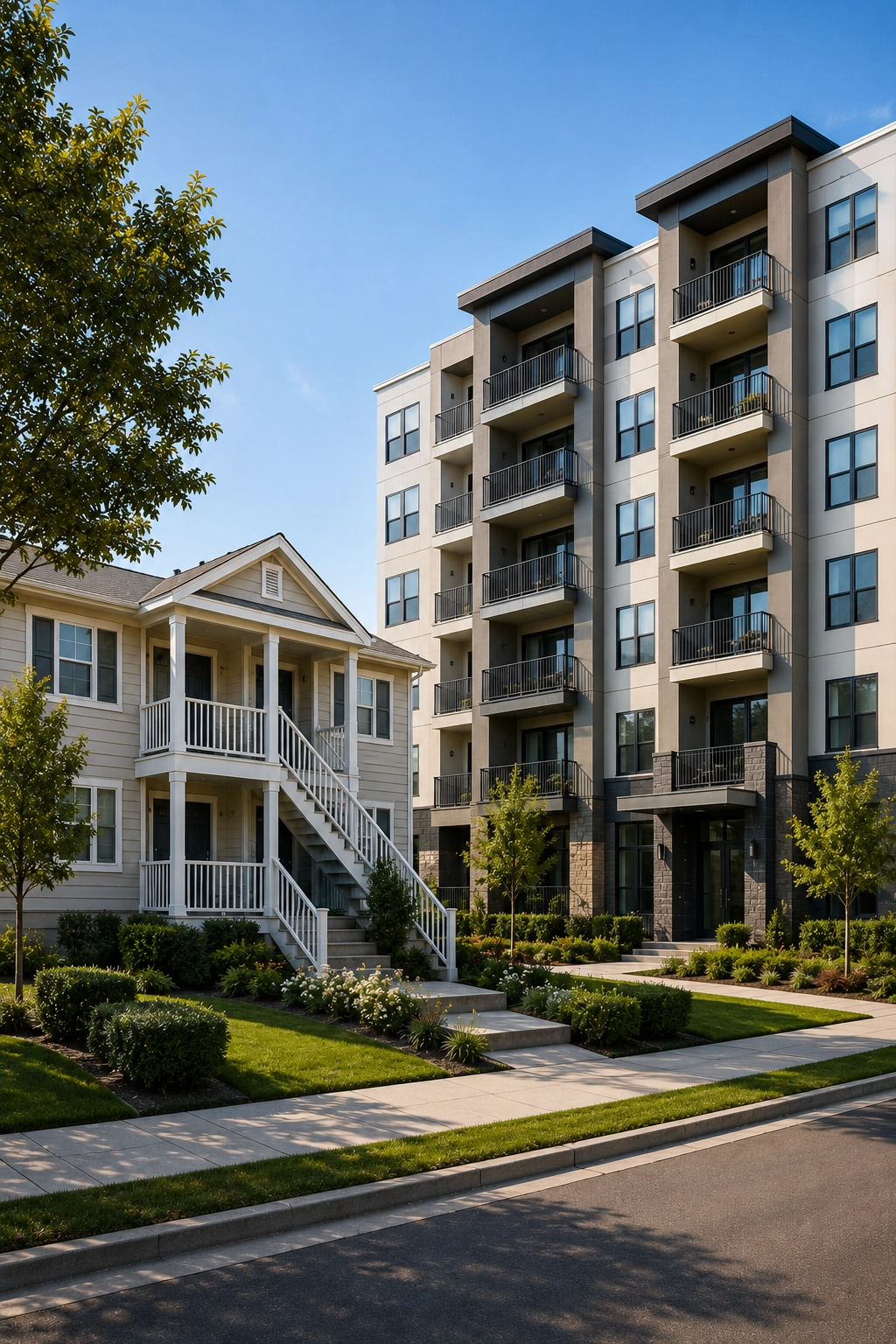
The Apartment Building Appraisal Process
While similar in structure to other appraisal types, California apartment building appraisals often require additional analysis related to income performance, tenant occupancy, operating expenses, market conditions, and investor expectations. Each step in the process is designed to support a credible, well-supported, and defensible valuation.
1. Assignment Definition
The appraiser identifies the intended use, effective date, property rights, and scope of work based on the specific requirements of the assignment.
2. Property Inspection
The property is inspected to evaluate overall condition, unit mix, occupancy characteristics, deferred maintenance, and physical features that may influence rental income and overall value.
Label
3. Income and Lease Analysis
Rent rolls, lease agreements, and market rental data are analyzed to determine income stability and potential.
Label
4. Market Research
Comparable apartment sales, capitalization rates, rental trends, investor activity, and local California market conditions are evaluated to support the valuation analysis.
Label
5. Valuation Analysis
Income-based valuation methods, including capitalization analysis and income approach modeling, are applied along with supporting valuation methodologies where appropriate.
6. Reporting
The final report clearly presents the methodology, assumptions, and conclusions in a format suitable for financial, legal, or investment use.
Apartment Building Appraisals for Legal and Financial Use
Apartment building appraisals are often required in situations where accuracy, clarity, and defensibility are critical. These assignments frequently involve legal, tax, estate, or financial matters where the valuation must clearly reflect how income performance, market conditions, investor behavior, and potential regulatory considerations influence value.
-
Attorneys
-
CPAs and tax professionals
-
Trustees and executors
-
Courts and mediators
-
Property owners and investors
-
IRS And Tax Reporting
Because these assignments often involve legal or financial consequences, California apartment building appraisals must be supported by credible market data, sound income analysis, and clear, well-documented reporting that can withstand professional scrutiny.
Apartment Building Appraisal Coverage Across California
Collins & Associates provides apartment building appraisal services throughout Southern California and select markets statewide. Assignments regularly include multifamily and income-producing residential properties located within major metropolitan and investor-active regions across California, including:
-
Los Angeles County
-
Orange County
-
Riverside County
-
San Bernardino County
-
San Diego County
Local market knowledge plays a critical role in California apartment building valuation. Rental demand, operating expenses, capitalization rates, tenant regulations, and investor expectations can vary significantly by region, making it essential to analyze each property within its specific submarket and regulatory environment.
Work Directly with a Certified General Apartment Building Appraiser
Apartment building appraisals require a higher level of analysis than standard residential assignments. These properties are evaluated based on income performance, occupancy trends, operating expenses, investor behavior, and California market conditions, making experience and analytical clarity essential.
At Collins & Associates, every assignment is personally handled by David R. Collins, Certified General Appraiser (G.A.A., S.C.R.E.A.), with over 50 years of experience valuing income-producing properties and apartment buildings throughout California.

Meet Your Apartment Building Appraiser
David R. Collins, G.A.A., S.C.R.E.A.
Certified General Appraiser
David R. Collins brings decades of experience valuing multi-unit apartment buildings, including assignments involving estate planning, tax reporting, and legal matters. His work reflects a deep understanding of income-producing real estate and the financial metrics that drive value.
Many apartment building appraisals are subject to review by attorneys, accountants, and financial institutions. In these situations, experience is not optional—it directly impacts how well the valuation holds up under scrutiny.
Trusted for Apartment Building and Income Property Valuations
- Multi-unit property acquisitions and sales
- Estate and trust-related valuations
- IRS date of death appraisals
- Property tax assessment appeals
- Portfolio valuation for real estate investors
- Pre-sale and financial decision support
- California rent-controlled property analysis
Each appraisal is developed using an income-focused approach that reflects how apartment buildings are evaluated in the market, ensuring results that are both accurate and defensible.
Experience That Supports Accurate and Defensible Apartment Building Valuations
Apartment building appraisals require a detailed understanding of income-producing real estate, investor expectations, capitalization rates, and California market conditions. Assignments involving multi-unit properties often require analysis that extends beyond standard residential appraisal practices.
With decades of experience valuing income-producing properties and apartment buildings throughout California, Collins & Associates provides appraisal reports designed to support attorneys, CPAs, lenders, trustees, investors, and property owners in high-trust financial and legal matters.
Request An Apartment Building Appraisal (5+ Unit Properties)
Apartment building appraisals require a precise understanding of income performance, investor expectations, operating expenses, and California market dynamics. Whether you are evaluating a potential acquisition, preparing for a sale, or addressing a legal or tax-related matter, the valuation must accurately reflect how income-producing properties are analyzed within the market.
At Collins & Associates, every appraisal is personally completed by David R. Collins, Certified General Appraiser (G.A.A., S.C.R.E.A.), with over 50 years of experience valuing income-producing properties. Each report is developed with a focus on accuracy, clarity, and defensibility—especially in situations where the outcome has financial or legal implications.
If you need an apartment building appraisal, the process typically begins with a brief consultation to understand the property, its income structure, and the purpose of the appraisal. This ensures the scope of work is clearly defined and aligned with your specific needs from the start.
Most assignments begin with a straightforward consultation to gather key property details, including unit count, rent roll availability, occupancy characteristics, and the intended use of the appraisal report.
From there, the appraisal process moves forward efficiently with clear communication and a well-defined scope of work.

Apartment Building Appraisal FAQs
Schedule a Call Back with Dave Collins
Provide your contact information and Dave Collins will personally return your call to discuss your appraisal needs and timeline.
"*" indicates required fields