
Why the IRS May Reject a Standard Bank Appraisal

Many appraisers primarily perform lending-related work for banks and mortgage companies. Those assignments are commonly completed using standardized lending forms developed specifically for residential financing transactions.
However, when an appraisal is needed for estate planning, gifting, date-of-death valuation, litigation, or IRS-related matters, the reporting requirements are often very different.
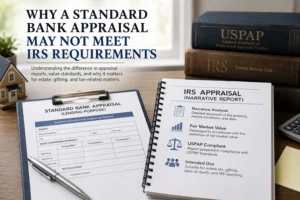
In many IRS-related assignments, a standard lending form appraisal may not be sufficient. The IRS generally expects a narrative appraisal report developed in compliance with USPAP standards and based on the definition of Fair Market Value.
Over the years, I have worked on assignments involving estates, trusts, tax matters, retrospective valuations, litigation support, and complex valuation issues throughout California. One of the reasons I often explain these reporting differences to clients is because selecting the wrong type of appraisal report can create unnecessary complications later.
Why Many Appraisers Default to Lending Forms
Most residential appraisers perform a significant amount of work for lenders. In those situations, the appraisal is typically prepared on a standardized form designed for mortgage underwriting purposes.
These reports are generally concise and highly structured because the intended user is usually a bank or lending institution.
For mortgage lending purposes, that format may be entirely appropriate.
However, IRS-related assignments often involve very different requirements and intended users, including:
- Attorneys
- CPAs
- Trustees
- Estate representatives
- Government agencies
- The IRS
- Courts and litigation matters
These types of assignments typically require expanded analysis, explanation, documentation, and reporting that go beyond what is commonly included in a standard lending appraisal form.
What the IRS Typically Requires
For many estate and tax-related assignments, the IRS generally expects a narrative appraisal report developed using the definition of Fair Market Value.
This differs from many lending assignments where the reporting format and valuation requirements may be tailored specifically for mortgage underwriting purposes.
A narrative appraisal report commonly includes:
- Detailed market analysis
- Expanded property descriptions
- Highest and best use analysis
- Comparable sales analysis
- Supporting market data
- Valuation methodology explanation
- USPAP certifications and disclosures
- Additional narrative discussion related to the assignment
The purpose of a narrative report is to fully explain the reasoning, data, and methodology supporting the value conclusion.
These types of reports are commonly associated with assignments such as:
- IRS Date of Death Appraisals
- IRS Estate Planning Appraisals
- IRS Estate & Gifting Appraisals
- Expert Witness & Litigation Support
- Real Estate Appraisal Reviews
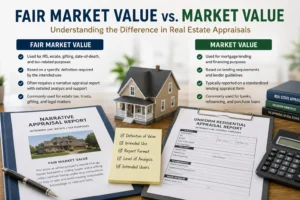
Fair Market Value vs. Market Value
One of the questions I frequently receive involves the difference between Fair Market Value and Market Value.
At first glance, the two definitions appear very similar. Both generally assume a willing buyer and a willing seller, neither acting under undue pressure, and both having reasonable knowledge of relevant facts surrounding the transaction.
However, the distinction becomes important because the definition of value used in an appraisal depends on the intended use of the assignment.
For many mortgage lending transactions, appraisers are asked to develop an opinion of Market Value using reporting formats designed specifically for lenders and financial institutions.
For many estate, gifting, and date-of-death assignments, the IRS generally requires the appraisal to be developed using the definition of Fair Market Value. The appraisal report must also be prepared in a format appropriate for the intended use of the assignment.
In other words, the issue is often not simply the value conclusion itself. It is whether the appraisal was developed using the correct definition of value and reported in a manner that satisfies IRS requirements.
IRS Definition of Fair Market Value
“The price at which property would change hands between a willing buyer and a willing seller, neither being under any compulsion to buy or sell and both having reasonable knowledge of relevant facts.”
This definition is commonly used for estate tax, gifting, and date-of-death appraisal assignments.
David R. Collins, Certified General Appraiser:
“Many people assume a bank appraisal can automatically be used for estate or IRS purposes. In reality, the intended use of the appraisal often determines both the definition of value and the reporting format that should be used. That’s why it is important to understand the specific requirements before ordering an appraisal for an estate, gifting, or date-of-death assignment.”
While the differences between Fair Market Value and Market Value may appear subtle, selecting the correct definition of value can be extremely important in business, estate administration, trust matters, gifting transactions, litigation support, and retrospective date-of-death valuations.
What Is a (Full) Narrative Appraisal Report?
A narrative appraisal report is a more comprehensive reporting format commonly used for lending, legal, tax, estate, and complex valuation matters. Typically a full narrative appraisal report will consist of 60 to 100+ pages, in full detail.
Unlike a standardized lending form, a narrative report allows the appraiser to fully explain:
- The valuation process
- Market conditions
- Property-specific factors
- Relevant legal or economic considerations
- Income analysis where applicable
- The reasoning behind adjustments and conclusions
These reports are often reviewed by mortgage lending, attorneys, accountants, trustees, courts, government agencies, and the IRS.
What Is a Restricted Appraisal Report?
Under USPAP, appraisers may also prepare what is known as a Restricted Appraisal Report.
Historically, restricted appraisal reports were intended for limited use by a specifically identified client. Although USPAP reporting terminology has evolved over time, the term “restricted appraisal report” is still commonly used within the appraisal profession.
Depending on the assignment, a restricted appraisal report may range from a concise letter-style valuation to a report containing less detail than a full narrative appraisal report.
Whether a restricted appraisal report is appropriate depends entirely on the intended use, intended users, and specific requirements of the assignment.
What Is a Narrative Restricted Appraisal Report?
Under USPAP, appraisers may also prepare what is known as a Narrative Restricted Appraisal Report.
A narrative restricted appraisal report is a written appraisal report that provides the appraiser’s value conclusion and supporting analysis in a narrative format, but with less detail than a full narrative appraisal report. Although USPAP reporting terminology has evolved over time, the term “restricted appraisal report” is still commonly used within the appraisal profession but it doesn’t restrict the user.
At Collins and Associates, I have taken the USPAP requirements for a restricted appraisals and have created a summary narrative appraisal report, which typically consist of 20 to 40 pages.
Although the report may be shorter, the appraiser is still responsible for developing a credible opinion of value based on the scope of work required for the assignment.
Depending on the property and purpose of the appraisal, a narrative restricted appraisal report may include a concise discussion of the property, market data, valuation approach, assumptions, and final value conclusion.
Whether this type of report is appropriate depends entirely on the intended use, intended users, reporting requirements, and level of support needed for the assignment. However, at Collins and Associates we have found that a Narrative Restricted Appraisal Report contains all of the elements required to adequately value property for most appraisals assignments.
Common Situations Where (Full/Restricted) Narrative IRS Appraisals May Be Needed
Over the years, I have seen narrative appraisal reports commonly required for:
- Estate tax reporting
- Inherited property valuations
- Date-of-death valuations
- Trust administration
- Gifting purposes
- Partnership dissolution matters
- Divorce litigation
- Property tax disputes
- Retrospective valuation assignments
- Expert witness and litigation support
These assignments often involve business, legal, financial, or tax-related decisions where the quality and credibility of the appraisal report become especially important.
Questions You Should Ask Before Hiring an Appraiser for IRS-Related Work
If you are hiring an appraiser for an business, estate, tax, or legal matter, I believe it is important to ask a few key questions before moving forward:
- Do you regularly perform IRS-related appraisal assignments?
- Will the report be prepared as a narrative appraisal?
- Is the appraisal based on Fair Market Value?
- Do you have experience with retrospective valuations?
- Have you worked with attorneys, CPAs, or trustees?
- Is the report USPAP compliant?
These questions can help avoid situations where the wrong report format is prepared for the intended use of the assignment.
Work Directly With an Experienced California Appraiser
At Collins & Associates, I personally complete appraisal assignments involving business, estate, IRS, legal, tax, and complex valuation matters throughout Southern California.
My experience includes:
- Estate and trust valuations
- Date-of-death appraisals
- Property tax appeal appraisals
- Expert witness and litigation support
- Commercial and residential valuation assignments
- Complex and specialty property appraisals
If you need an appraisal for an IRS-related matter, business, legal proceeding, or estate planning purpose, understanding the proper reporting format and valuation requirements can make a significant difference.




Need an Appraisal?
Contact Dave for reliable, certified appraisals across California.