
AB 1482: Understanding California’s Tenant Protection Act and Statewide Rent Control

California’s Tenant Protection Act of 2019, commonly referred to as AB 1482, introduced statewide rent control and just-cause eviction protections for many residential rental properties throughout California. Since taking effect on January 1, 2020, the law has significantly impacted property owners, tenants, investors, and real estate professionals across the state.
While AB 1482 was designed to provide tenant protections and reduce displacement, it also introduced important valuation and investment considerations for rental property owners. Understanding which properties are covered, which are exempt, and how the law may influence income potential is important for anyone involved in California real estate.
At Collins & Associates, David R. Collins and the firm regularly analyze income-producing residential properties throughout Southern California, including some single family residential homes, small residential income units, apartment buildings and commercial mixed-use residential properties, where statewide rent control regulations may influence market behavior and valuation.
What Is AB 1482?
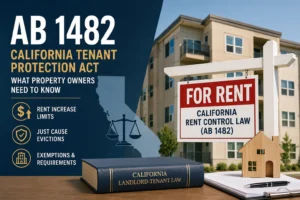
AB 1482, also known as the California Tenant Protection Act of 2019, established statewide limitations on annual rent increases while also requiring “just cause” protections for many residential tenants.
Under the law, annual rent increases are generally limited to:
- 5% plus local inflation (Consumer Price Index or CPI)
- Maximum annual increase capped at 10%
The law also prevents landlords from terminating certain tenancies without legally recognized “just cause” reasons once tenants have occupied the property for the required period under California law.
However, AB 1482 does not apply to every residential property in California. Several important exemptions exist depending on ownership structure, property type, occupancy status, and local municipal regulations.
How California’s Rent Cap Works Under AB 1482
The statewide rent cap formula under AB 1482 allows landlords to increase rent annually by:
5% + Local CPI (Consumer Price Index)
However, total increases cannot exceed 10% within a 12-month period.
For example:
- If local inflation is 2%, the maximum increase would generally be 7%
- If local inflation reaches 8%, the increase would still be capped at 10%
The law applies to many multi-family and income-producing residential properties throughout California, particularly older apartment buildings and rental housing stock.
For investors and appraisers, these limitations can affect:
- Projected rental income growth
- Investment return expectations
- Market value analysis
- Income capitalization considerations
- Long-term asset positioning
What “Just Cause” Eviction Means
AB 1482 also established statewide “just cause” eviction requirements for many covered properties. Once a tenant has occupied a unit long enough to qualify under the law, landlords generally cannot terminate the tenancy without a legally recognized reason.
At-Fault Just Cause
Examples may include:
- Nonpayment of rent
- Lease violations
- Criminal activity
- Property damage
- Nuisance behavior
No-Fault Just Cause
Examples may include:
- Owner move-in
- Substantial remodels
- Removal of property from rental market
- Government orders requiring vacancy
In many no-fault situations, landlords may also be required to provide relocation assistance to tenants.
Properties Exempt From AB 1482
Several categories of California properties are exempt from statewide rent caps and just-cause protections under AB 1482.
1. New Construction
Residential properties built within the last 15 years are generally exempt from statewide rent control restrictions. This exemption operates on a rolling basis.
For example, a property constructed in 2012 may remain exempt until it reaches the 15-year threshold.
This exemption was intended to encourage housing development by allowing newer properties to operate closer to market rental conditions.
2. Single-Family Homes and Condominiums
Single-family homes, townhomes, and condominiums may qualify for exemption if:
- The property is owned by an individual
- The owner is a family trust
- The property is owned by an LLC with no corporate member
However, if the property is owned by:
- A corporation
- A Real Estate Investment Trust (REIT)
- An LLC with a corporate member
The exemption generally does not apply.
Importantly, landlords claiming this exemption must provide tenants with a legally compliant written notice stating the property is exempt from AB 1482 protections.
3. Owner-Occupied Duplexes
Duplexes may qualify for exemption if the owner occupies one of the units as their primary residence from the beginning of the tenancy and continues to reside there.
Certain owner-occupied room rental situations may also qualify for exemption under California law.
4. Affordable and Subsidized Housing
Some deed-restricted affordable housing properties are exempt from AB 1482 because they are already regulated under separate government affordability programs.
However, market-rate properties that accept Section 8 Housing Choice Vouchers are not automatically exempt.
5. Institutional Housing
Some institutional housing categories are exempt, including:
- College and university dormitories
- Certain nonprofit housing facilities
- Licensed care facilities
6. Hotels and Transient Occupancy
Hotels, motels, and transient occupancy properties intended for short-term stays are generally exempt from statewide rent control protections.
Local Rent Control Ordinances May Still Apply
One of the most misunderstood aspects of AB 1482 is that statewide exemptions do not automatically eliminate local rent control requirements.
Several California cities maintain their own rent stabilization ordinances that may impose stricter regulations than state law.
Examples include:
- Los Angeles
- Santa Monica
- West Hollywood
- San Francisco
- Oakland
In some cases, local ordinances may override portions of statewide exemptions or impose additional compliance obligations.
Property owners should always verify local municipal requirements before assuming a property is exempt from rent control regulations.
Why Disclosure Requirements Matter
AB 1482 exemption status is not always automatic.
California law generally requires landlords to provide proper written disclosures informing tenants that the property is exempt from statewide rent cap and just-cause protections.
Failure to provide proper notice may unintentionally subject an otherwise exempt property to portions of AB 1482.
This issue has become increasingly important for:
- Small income property owners
- Real estate investors
- Estate administrators
- Trust-owned residential properties
- Multi-family property operators
How AB 1482 Can Impact Property Values and Real Estate Appraisals
Statewide rent control laws can influence the valuation of income-producing residential properties because investors often evaluate properties based on income stability, growth potential, and operating restrictions.
AB 1482 may affect:
- Projected future rental income
- Income capitalization rates
- Buyer demand
- Investor risk perception
- Long-term redevelopment strategies
For appraisers, these considerations may become relevant when analyzing:
- Small Income Unit Appraisals
- Apartment Building Appraisals
- Multi-Family Residential Appraisals
- Mixed-Use Commercial & Residential Appraisals
In some situations, appraisers may need to analyze:
- Current versus market rents
- Rent-controlled occupancy impacts
- Tenant stability
- Deferred rental growth potential
- Local ordinance restrictions
These factors can become particularly relevant in litigation, tax disputes, estate planning, partnership dissolutions, and investment decision-making.
The Importance of Professional Appraisal Analysis
Properties affected by rent control regulations often require more than a standard residential valuation approach. Income-producing properties may involve additional analysis related to lease structures, rental restrictions, operating expenses, and investor behavior.
David R. Collins of Collins & Associates has extensive experience analyzing residential and commercial income-producing properties throughout Southern California, including assignments involving litigation support, estate planning, tax appeals, and IRS-related valuation matters.
The firm’s experience includes:
- Property Tax Assessment Appeal Appraisals
- IRS Estate Planning Appraisals
- IRS Date of Death Appraisals
- Expert Witness Real Estate Appraisal Services
- Real Estate Appraisal Reviews
As California housing regulations continue to evolve, understanding how legal restrictions may influence property value remains increasingly important for owners, attorneys, trustees, and investors.
Frequently Asked Questions About AB 1482
Does AB 1482 apply to single-family homes?
Some single-family homes are exempt if they are individually owned and proper exemption notices are provided to tenants.
Are condos exempt from California rent control?
Many condominiums qualify for exemption if ownership requirements are met and proper disclosures are provided.
Does AB 1482 apply to duplexes?
Owner-occupied duplexes may qualify for exemption if the owner lives in one of the units as their primary residence.
Can landlords increase rent 10% every year?
Not necessarily. The formula is generally 5% plus local CPI, capped at 10% total annually.
Do local city rent control laws override AB 1482?
In some cases, yes. Local rent stabilization ordinances may impose stricter requirements than statewide law.
Why do exemption disclosures matter?
Failure to provide legally required exemption notices may affect whether a property qualifies for AB 1482 exemptions.
Final Thoughts on California’s Tenant Protection Act
AB 1482 introduced significant changes to California’s rental housing landscape and continues to influence property ownership, investment analysis, and valuation considerations throughout the state.
While statewide rent control regulations may not apply to every property, understanding exemptions, disclosure requirements, and local ordinance interactions is essential for informed real estate decision-making.
For owners and investors of income-producing residential properties, professional appraisal analysis can provide important insight into how market conditions, regulatory restrictions, and rental limitations may influence property value.




Need an Appraisal?
Contact Dave for reliable, certified appraisals across California.