
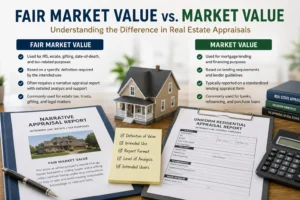
Fair Market Value vs. Market Value: What Is the Difference in Real Estate Appraisals?

One of the questions I am often asked is whether Market Value and Fair Market Value mean the same thing in a real estate appraisal.
The easiest way to understand the difference is to think of “probable” vs. “hypothetical.”
Market Value is an estimate of what a property will most probably sell for in the actual, messy, current real estate market under standard mortgage terms.
Fair Market Value is a legal construct that estimates what an asset is worth in a frictionless, perfectly balanced, hypothetical economic vacuum.
Because Fair Market Value relies on these assumed conditions rather than every pressure affecting the current market, Fair Market Value and Market Value are not always identical.
Definition of Market Value
As defined by the courts, this term is:
The most probable price which a property should bring in a competitive and open market under all conditions requisite to a fair sale, the buyer and the seller, each acting prudently, knowledgeably and assuming the price is not affected by undue stimulus. Implicit in this definition is the consummation of a sale as of a specified date and passing of the title from seller to buyer under conditions whereby: (1) buyer and seller are typical motivated; (2) both parties are well informed or well advised, and each acting in what he considers his own best interest; (3) a reasonable time is allowed for exposure in the open market; (4) payment is made in cash of US dollars or in terms of financial arrangements comparable thereto; and (5) the price represents the normal consideration for the property sold unaffected by special or creative financing or sales concessions granted by anyone associated with the sale.
Adjustments to the comparable must be made for special or creative financing or sales concessions. No adjustment are necessary for those costs, which are normally paid by the sellers as a result of tradition or law in a market area; these costs are readily identifiable since the seller pays these costs in virtually all-states transactions. Special or creative financing adjustments cam be made to the comparable property by comparisons to financing terms offered by a third party institutional lender that is not already involved in the property or transaction. Any adjustment should not be calculated on a mechanical dollar for dollar cost of the financing or concession but the dollar amount of any adjustments should approximate the market’s reaction to the financing or concessions based on the appraiser’s judgement.
From the Interagency Appraisal and Evaluations Guidelines (December 2, 2010 and Federal Registry Vo. 75 No. 237 / December 10, 2010.
DATE OF VALUE
The market Value estimate is made based upon conditions prevailing as of the effective date of valuation.
Special or Creative Financing and Sales Concessions
Adjustments to the comparable must be made for special or creative financing or sales concessions.
No adjustments are necessary for those costs that are normally paid by sellers as a result of tradition or law in a market area. These costs are readily identifiable because the seller pays them in virtually all transactions.
Special or creative financing adjustments can be made to the comparable property by comparing the financing terms with those offered by a third-party institutional lender that is not already involved in the property or transaction.
Any adjustment should not be calculated mechanically on a dollar-for-dollar basis based on the cost of the financing or concession. Instead, the amount of the adjustment should approximate the market’s reaction to the financing or concessions based on the appraiser’s judgment.
Source: Interagency Appraisal and Evaluation Guidelines, December 2, 2010, and Federal Register, Volume 75, Number 237, December 10, 2010.
Date of Value
The Market Value estimate is made based upon conditions prevailing as of the effective date of valuation.
The effective date is important because real estate markets change over time. Interest rates, available inventory, buyer demand, financing conditions, property conditions, and comparable sales may be different on one date than they are on another.
An appraisal must therefore identify the specific date as of which the value opinion applies.
Definition of Fair Market Value
Fair Market Value is commonly used in IRS-related appraisal assignments, including estate tax matters, gifting, date-of-death valuations, inherited property valuations, and other tax-related purposes.
The IRS definition of Fair Market Value appears in Section 20.2031-1(b) of the Estate Tax Regulations.
IRS Definition of Fair Market Value
The fair market value is the price at which the property would change hands between a willing buyer and a willing seller, neither being under any compulsion to buy or to sell and both having reasonable knowledge of relevant facts.
The fair market value of a particular item of property includible in the decedent’s gross estate is not to be determined by a forced sale price.
Nor is the fair market value of an item of property to be determined by the sale price of the item in a market other than that in which such item is most commonly sold to the public, taking into account the location of the item wherever appropriate.
Source: 26 CFR §20.2031-1(b), Valuation of Property in General.
What Does the Fair Market Value Definition Mean?
Fair Market Value generally represents the price at which property would change hands between a hypothetical willing buyer and a hypothetical willing seller.
The definition assumes that:
- Both parties are willing to complete the transaction
- Neither party is under compulsion to act
- Both parties have reasonable knowledge of relevant facts
- The property is not being valued based on a forced sale
- The property is considered within the market in which it is most commonly sold
- The property’s location is considered when appropriate
Fair Market Value is frequently required when an appraisal will be used for an estate, gifting, inheritance, trust, tax, IRS-related purposes, legal and business purposes.
Fair Market Value vs. Market Value: Understanding the Distinction and its Importance in Real Estate
Fair Market Value (FMV) and Market Value (MV) are two terms that are commonly used in real estate and property valuation. They both refer to the worth of a property, but they serve different purposes and can sometimes yield different results. This is an in-depth look at these two concepts, their differences, and their significance in real estate transactions.
Fair Market Value (FMV):
FMV is the price that a property would sell for on the open market, under normal conditions where both the buyer and seller are reasonably knowledgeable about the property, and neither is compelled to buy or sell. This value is often used for tax purposes and insurance claims and is crucial in estate planning and other legal proceedings. Determining FMV is a complex process that takes into account various factors, including the property’s location, condition, and recent sale prices of comparable properties.
Market Value (MV):
Market Value, on the other hand, is the estimated amount for which a property should exchange on the date of valuation between a willing buyer and a willing seller in an arm’s-length transaction after proper marketing wherein the parties had each acted knowledgeably, prudently, and without compulsion. It’s a more dynamic value influenced by current market conditions, including supply and demand and buyer sentiment. This is a description of the most probably price a property should bring in a competitive, open market under normal, fair sales conditions.
Comparing FMV and MV:
Although FMV and MV might seem similar, their use and calculation can differ:
- Use: FMV is often used for legal and tax-related purposes. In contrast, MV is primarily used for listing and offering prices during real estate transactions.
- Determination: FMV often uses historical data and is influenced by a hypothetical transaction scenario, whereas MV is much more influenced by current market conditions and trends.
- Variance: FMV, due to its dependence on ideal conditions and theoretical situations, can sometimes differ substantially from the MV, especially in volatile or fast-moving real estate markets, indicating a higher value.
Conclusion:
While both Fair Market Value and Market Value aim to estimate a property’s worth, they do so from different perspectives and for different purposes. Understanding these differences is important for both buyers and sellers in making informed decisions. Working with a real estate professional can help navigate these concepts and apply them effectively to your unique situation.
The Core Difference
While both terms estimate a property’s worth, market value is dynamic and based on what actual buyers are paying right now. Fair market value is a strict, hypothetical standard used to ensure an asset is valued fairly for tax or legal purposes.
Fair Market Value (FMV) Examples of Different Market Conditions
Scenario 1: FMV is Higher Than Market Value (Buyer’s Market / Downturn)
In a crashing or severely depressed real estate market, FMV will almost always produce a higher value than the actual probable market price.
The Real World (Market Value): The market is flooded with foreclosures and short sales. Sellers are panicked and desperate to unload properties, leading to distressed, “fire-sale” pricing.
The Economic Vacuum (FMV): FMV assumes a healthy, stable environment where no one is forced to sell. Because it legally disqualifies “distressed” or “panic” pricing, the calculated FMV remains higher than what a desperate seller would actually accept on the street.
Scenario 2: FMV is Lower Than Market Value (Seller’s Market / Bubble)
Conversely, in a hyper-aggressive, overheated market, FMV will usually be lower than the actual probable market price.
The Real World (Market Value): Buyers are caught up in emotional bidding wars. They waive home inspections, ignore financial fundamentals, and pay significantly over asking price due to a fear of missing out (FOMO).
The Economic Vacuum (FMV): FMV assumes a strictly rational and fully informed buyer. Because a purely rational buyer in a vacuum would not overpay due to emotional panic, the FMV calculation strips away that “market froth,” resulting in a lower, more conservative valuation.
Why the Discrepancy Matters
This difference is exactly why courts, tax authorities (like the IRS), and insurance companies rely on FMV rather than actual daily market value. They want to determine what the asset is worth based on economic fundamentals, completely insulated from temporary market panics, distress, or emotional bubbles.
Why a Bank Appraisal May Not Be Appropriate for IRS Purposes
A common mistake is assuming that an appraisal prepared for a bank can automatically be submitted for an estate, gifting, tax, or IRS-related matter.
A bank appraisal is generally prepared for lending and collateral evaluation. Its intended user is usually the financial institution that ordered the appraisal.
An IRS-related appraisal is prepared for a different intended use and may need to include:
- The applicable Fair Market Value definition
- The correct estate, gifting, or tax effective date
- The appropriate intended-use and intended-user language
- A detailed description of the property
- Market conditions as of the relevant date
- Comparable sale or income analysis
- Discussion of the valuation methodology
- Support for adjustments and assumptions
- Appraiser qualifications and certifications
A lending appraisal is not necessarily incorrect or deficient. It was simply prepared for a different intended use.
For a deeper explanation, read Why a Standard Bank Appraisal May Not Meet IRS Requirements.
Why the Appraisal Report Format Matters
The definition of value is only one part of the appraisal assignment. The reporting format must also be appropriate for the intended use and intended users.
Many residential lending appraisals are completed on standardized forms designed to provide lenders with the information needed for underwriting and collateral analysis.
Estate, tax, gifting, litigation, and complex commercial appraisal assignments may require a more detailed narrative appraisal report.
A narrative appraisal report may provide greater explanation of:
- The property and property rights appraised
- The intended use and intended users
- The applicable definition of value
- The effective date of the appraisal
- The relevant regional and local market
- The property’s highest and best use
- The comparable properties analyzed
- The adjustments applied
- The valuation approaches used
- The appraiser’s reasoning and final reconciliation
This additional support can be important when the appraisal may be reviewed by an attorney, CPA, trustee, estate representative, court, government agency, lender, or the IRS.
Questions to Ask Before Ordering an Appraisal
Before engaging an appraiser, explain why the appraisal is needed and who is expected to rely on the report.
Important questions may include:
- Will the appraisal be used for lending, estate, tax, gifting, trust, or legal purposes?
- Who is the client?
- Who are the intended users?
- Does the assignment require Market Value or Fair Market Value?
- Is there a specific legal, regulatory, court, or agency definition that must be applied?
- What is the required effective date?
- Is the valuation current, retrospective, or prospective?
- What property rights must be appraised?
- Is a narrative appraisal report appropriate?
- Will the report be reviewed by a lender, attorney, CPA, trustee, court, government agency, or the IRS?
- Does the appraiser regularly complete this type of assignment?
Addressing these questions before the appraisal begins can help prevent the wrong definition of value, effective date, scope of work, or reporting format from being used.
Related Real Estate Appraisal Resources
These resources provide additional information about estate, tax, lending, legal, and real estate appraisal assignments:
- Why a Standard Bank Appraisal May Not Meet IRS Requirements
- What Is a Date of Death Appraisal? Complete Guide
- Types of Real Estate Appraisals
- Estate Planning Tips
- Expert Witness Appraiser Guide
- Real Estate Appraisal Reviews
Work With an Appraiser Who Understands the Assignment
At Collins & Associates, I personally complete real estate appraisal assignments involving Market Value, Fair Market Value, estate planning, date-of-death valuations, gifting, taxation, litigation, financing, and complex property matters throughout Southern California.
My appraisal experience includes:
- Market Value appraisals
- Fair Market Value appraisals
- Date-of-death valuations
- Estate and trust appraisals
- IRS-related appraisal assignments
- Gifting appraisals
- Retrospective valuations
- Commercial property appraisals
- Residential property appraisals
- Real estate appraisal reviews
- Expert witness and litigation support
Before accepting an assignment, I work to identify the appraisal’s intended use, intended users, applicable definition of value, appropriate effective date, property rights being appraised, and reporting requirements.
This helps ensure that the appraisal is developed for the actual purpose for which it will be used.







Need an Appraisal?
Contact Dave for reliable, certified appraisals across California.