
Market Value Defined
As defined by the courts, this term is:
The most probable price which a property should bring in a competitive and open market under all conditions requisite to a fair sale, the buyer and the seller, each acting prudently, knowledgeably and assuming the price is not affected by undue stimulus. Implicit in this definition is the consummation of a sale as of a specified date and passing of the title from seller to buyer under conditions whereby: (1) buyer and seller are typical motivated; (2) both parties are well informed or well advised, and each acting in what he considers his own best interest; (3) a reasonable time is allowed for exposure in the open market; (4) payment is made in cash of US dollars or in terms of financial arrangements comparable thereto; and (5) the price represents the normal consideration for the property sold unaffected by special or creative financing or sales concessions granted by anyone associated with the sale.
Adjustments to the comparable must be made for special or creative financing or sales concessions. No adjustment are necessary for those costs, which are normally paid by the sellers as a result of tradition or law in a market area; these costs are readily identifiable since the seller pays these costs in virtually all-states transactions. Special or creative financing adjustments cam be made to the comparable property by comparisons to financing terms offered by a third party institutional lender that is not already involved in the property or transaction. Any adjustment should not be calculated on a mechanical dollar for dollar cost of the financing or concession but the dollar amount of any adjustments should approximate the market’s reaction to the financing or concessions based on the appraiser’s judgement.
From the Interagency Appraisal and Evaluations Guidelines (December 2, 2010 and Federal Registry Vo. 75 No. 237 / December 10, 2010.
DATE OF VALUE
The market Value estimate is made based upon conditions prevailing as of the effective date of valuation.
Fair Market Value Defined
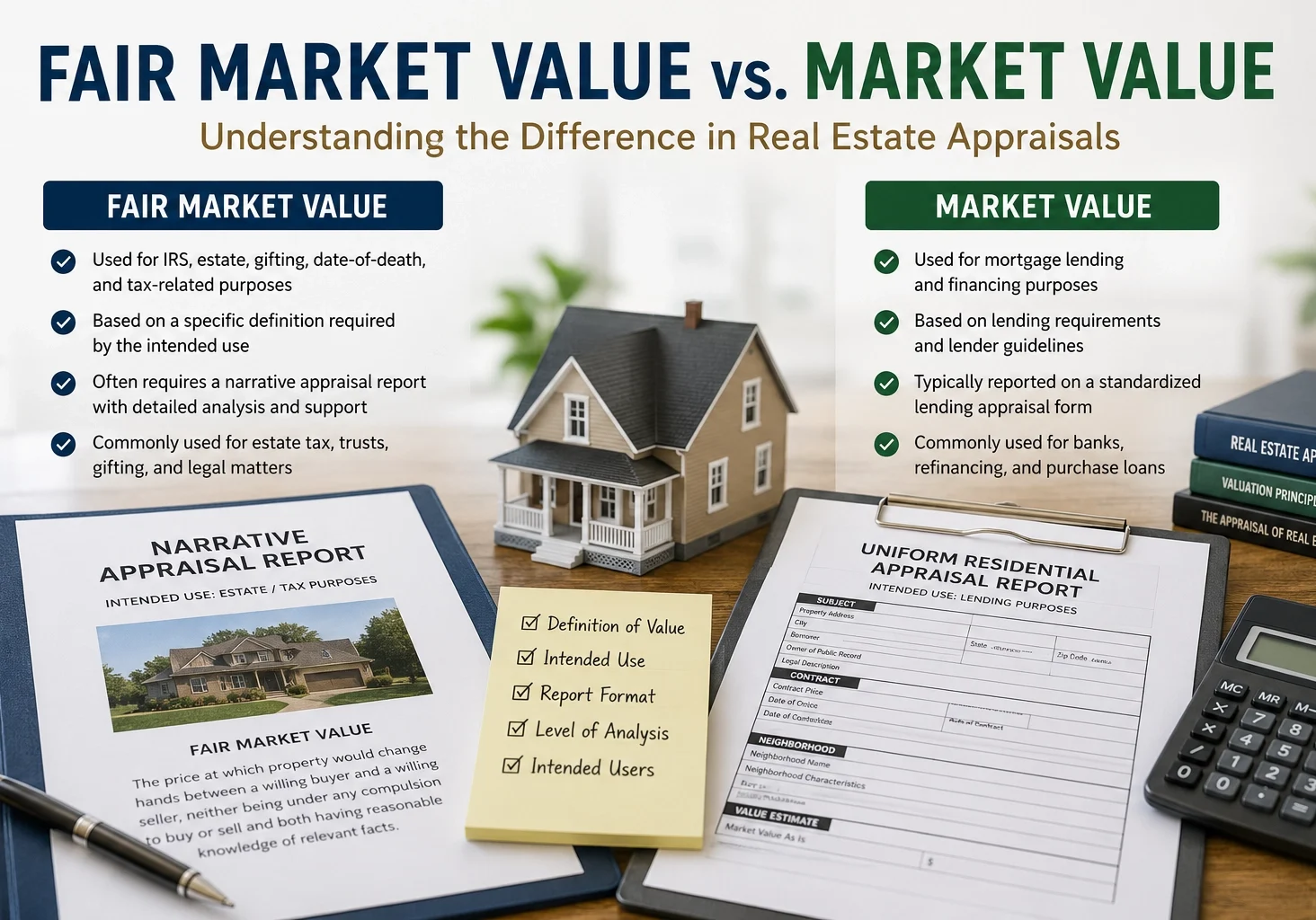
Fair Market Value is defined as: The fair market value is the price at which the property would change hands between a willing buyer and a willing seller, neither being under any compulsion to buy or sell and both having reasonable knowledge of relevant facts. The fair market value of a particular item of property includible in the decedent’s gross estate sale is not to be determined by a forced sale price. Nor is the fair market value of an item of property to be determined by a forced sale price of the item in a market other than that in which such item is mostly commonly sold to the public, taking into account the location of the item wherever appropriate. ""Regulation20.203-1.
What is Difference Between Fair Market Value vs. Market Value in Real Estate?
The easiest way to understand the difference is to think of “probable” vs. “hypothetical.”
Market Value is an estimate of what a property will most probably sell for in the actual, messy, current real estate market under standard mortgage terms.
Fair Market Value is a legal construct that estimates what an asset is worth in a frictionless, perfectly balanced, hypothetical economic vacuum.
Because Fair Market Value relies on these assumed conditions rather than every pressure affecting the current market, Fair Market Value and Market Value are not always identical.
For deeper explanation, read Fair Market Value vs. Market Value: What Is the Difference in Real Estate Appraisals?
Retroactive Valuation
Unlike a standard appraisal based on today’s market, a Date of Death Appraisal is a retrospective analysis. The appraiser must reconstruct the market conditions that existed on the specific date of death—reviewing comparable sales, market trends, supply and demand factors, and economic conditions at that historical point in time. The appraiser's task is to normalize real-world transactional anomalies (such as emotional bidding wars, panic selling, or distressed transfers) to align with this idealized baseline.
The IRS requires an accurate valuation for:
- Estate tax reporting (Form 706, when applicable)
- Determining capital gains basis for heirs
- Trust administration and asset distribution
- Probate court filings
- Resolving disputes among beneficiaries
A properly prepared California Date of Death Valuation ensures that the estate reflects accurate property value for tax compliance and legal clarity.

Fractional and Multi-Entity Interests
Where ownership is divided across family members or entities, valuation must reflect the property’s characteristics as well as the ownership structure. Assignments involving layered entities or shared control demand analytical precision.
These matters require experience, not template reporting.
Why the IRS Requires It
The IRS requires an accurate valuation for:
- Estate tax reporting (Form 706, when applicable)
- Determining capital gains basis for heirs
- Trust administration and asset distribution
- Probate court filings
- Resolving disputes among beneficiaries
A properly prepared California Date of Death Valuation ensures that the estate reflects accurate property value for tax compliance and legal clarity.
For a more detailed breakdown of how date of death appraisals work, including IRS requirements and valuation methods, review our date of death appraisal guide complete guide.
Why IRS Compliance Matters
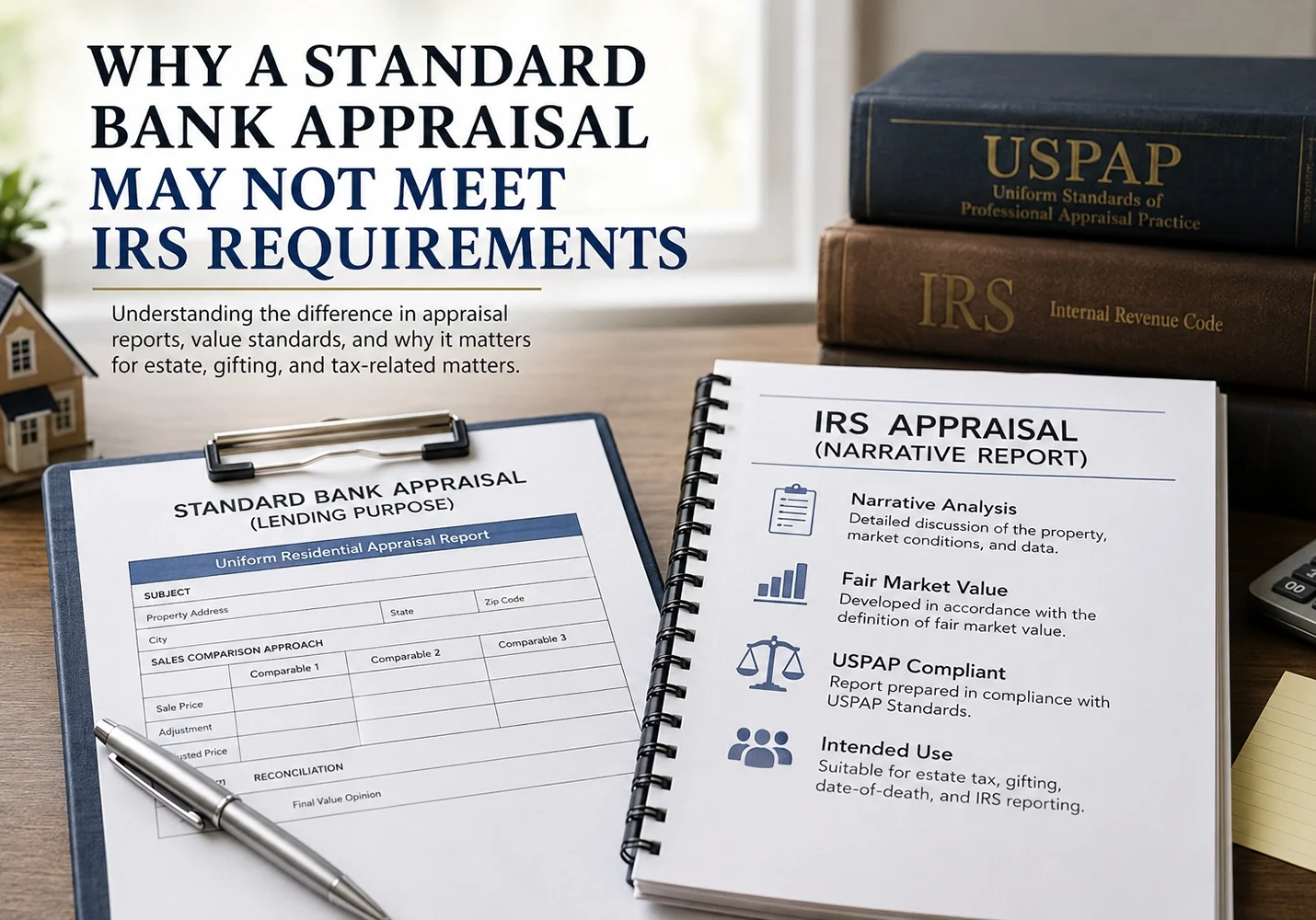
Not all appraisals meet IRS standards. A generic market valuation or broker price opinion (BPO) is insufficient for estate reporting. The IRS expects appraisals prepared by qualified professionals that adhere to recognized valuation standards.
An IRS-Compliant Date of Death Appraisal in California protects the estate, executor, and heirs from unnecessary financial and legal risk.
Who Needs a Date of Death Appraisal in California?
A Date of Death Appraisal is typically required by:
-
Executors administering estates
-
Certified Public Accountants (CPAs) handling tax reporting
-
Probate administrators
-
Estate attorneys preparing probate filings
-
Trustees overseeing trust assets
-
Families managing estate settlement
Estate matters operate on strict timelines. Waiting can complicate tax reporting, create documentation gaps, and increase the risk of valuation challenges. A properly prepared Date of Death appraisal establishes defensible basis and protects all parties involved.
The most prudent course is to secure the valuation promptly while market data is verifiable and filing requirements are still within compliance windows.
Why Choose Collins & Associates
When an appraisal is required for IRS reporting, estate administration, or legal proceedings, experience matters.

David R. Collins, G.A.A., S.C.R.E.A.
Certified General Appraiser
Over 50 Years of Valuation Experience
Collins & Associates is led by David R. Collins, a Certified General Appraiser with over five decades of real estate valuation experience across Southern California.
His background includes complex assignments involving estate taxation, trust administration, litigation support, and high-value properties—far beyond routine lending appraisals.
Certified General Appraiser – Qualified for Complex Assignments
As a Certified General Appraiser (G.A.A., S.C.R.E.A.), David R. Collins is qualified to appraise:
- Residential properties
- Income-producing properties
- Commercial and industrial assets
- Multi-parcel estates
- Unique and specialized real estate
This credential level is required for higher-complexity and higher-value assignments.
Extensive IRS & Estate Appraisal Experience
Collins & Associates regularly prepares:
- IRS-compliant Date of Death Appraisals
- Retrospective valuations
- Estate and gifting appraisals
Reports are prepared to meet IRS reporting standards and are supported by thorough market analysis and defensible methodology.
Trusted by Attorneys & Financial Professionals
For decades, Collins & Associates has worked alongside:
- Estate planning attorneys
- Probate attorneys
- CPAs and tax advisors
- Trustees and executors
Many assignments come through professional referrals, reflecting long-standing trust in the firm’s experience and objectivity.
Expert Witness & Litigation Capability
Unlike many appraisal firms focused solely on lending work, Collins & Associates has experience providing expert witness testimony and preparing valuations for legal matters, including:
- Trust disputes
- Estate litigation
- Eminent domain matters
- Divorce
- Insurance Claims
This litigation background reinforces the strength and defensibility of each report.
California Statewide Market Coverage
Collins & Associates provides appraisal services throughout the State of California. Assignments span urban, suburban, and specialized property markets across Northern, Central, and Southern California.
With decades of valuation experience, the firm understands regional market variations, historical pricing cycles, and county-level reporting standards necessary for credible retrospective analysis and litigation support.
Not a Refinance Appraisal Firm
Most appraisal firms concentrate on refinance and lending assignments.
Collins & Associates specializes in high-trust valuation work — including IRS, estate, legal, and complex property matters — where accuracy, documentation, and defensibility are critical.
Counties Served
Collins & Associates provides IRS-Compliant Date of Death Appraisals throughout California, including:
-
Los Angeles County
-
Orange County
-
Riverside County
-
San Bernardino County
-
San Diego County
These county pages provide location-specific information, while this page serves as the statewide authority resource.
Schedule an IRS-Compliant Date of Death Appraisal
If you require an IRS-Compliant Date of Death Appraisal in California, Collins & Associates provides independent, defensible, and professionally documented valuations tailored to estate, trust, and tax requirements.
Contact us to discuss your assignment, timeline, and reporting needs, for a consultation.

Frequently Asked Questions



Schedule a Call Back with Dave Collins
Provide your contact information and Dave Collins will personally return your call to discuss your appraisal needs and timeline.
"*" indicates required fields