
Residential appraisals are used to establish a well-supported opinion of value for a home or residential property based on market data, property characteristics, location, condition, and the purpose of the assignment. Whether the appraisal is needed for estate planning, trust administration, tax reporting, litigation, divorce, gifting, or a private transaction, the quality of the report matters. A residential appraisal should do more than produce a number. It should explain how value was developed, reflect recognized appraisal methodology, and hold up to review when the assignment involves legal, financial, or tax-related consequences.
Collins & Associates provides residential appraisal services throughout Southern California for a wide range of intended uses. Assignments may involve single-family properties include homes, condominiums, townhomes, small residential income properties, apartments, custom homes, estate properties, high-value homes, properties with unique characteristics, or situations where valuation is disputed or closely scrutinized. Our work is grounded in market analysis, defensible reporting, and a clear understanding of how residential value issues arise in real-world legal, tax, and ownership contexts.
What a Residential Appraisal Is
A residential appraisal is a professional opinion of value developed by a qualified real estate appraiser using accepted appraisal methods. In most cases, the report includes an inspection, neighborhood and market analysis, review of relevant property data, selection of comparable sales, and adjustments based on meaningful differences between the subject property and the market evidence.
The exact scope of work depends on the intended use of the appraisal. A residential appraisal prepared for a date of death assignment, for example, is not approached the same way as one developed for divorce litigation, an estate settlement, or a current fair market value opinion for planning purposes. The intended user, effective date, property type, and reporting requirements all influence how the assignment is completed.
At its core, a credible residential appraisal answers key questions such as:
- What is the property worth as of the relevant effective date
- What market evidence supports that conclusion
- How does the subject compare to recent sales and competing listings
- Are there characteristics that make the property more difficult to compare or analyze
- Does the report clearly explain the reasoning behind the final value conclusion


Types of Residential Properties Commonly Appraised
Residential assignments can vary widely in complexity. Some involve standard owner-occupied properties in active subdivisions, while others involve custom homes, large lots, view properties, non-conforming improvements, or homes held in trusts or estates.
Collins & Associates performs residential appraisals for property types that may include:
- Single-family residences
- Condominiums
- Townhomes
- Planned unit developments
- Luxury and high-value residential properties
- Waterfront and view homes
- Custom homes
- Estate properties
A residential property may appear simple at first glance but still present meaningful valuation issues. Unique upgrades, deferred maintenance, unusual site characteristics, accessory improvements, legal nonconformity, limited comparable data, or changing market conditions can all affect the assignment.
When Residential Appraisals Are Needed
Residential appraisals are often associated with lending, but many of the most important assignments occur outside the mortgage process. In those situations, the appraisal often needs greater narrative support, closer analysis, and a clearer explanation of methodology.
Common non-lending uses for residential appraisals include:
Estate and Trust Administration
When a homeowner passes away or real property is transferred through a trust, the parties involved often need a well-supported valuation for tax reporting, administration, or distribution purposes. In these matters, the effective date is often critical, especially when the value must reflect a past date rather than current market conditions.
Date of Death Appraisals
A date of death appraisal is used to determine the fair market value of residential real estate as of the property owner’s date of death. These appraisals are often relevant for probate, trust administration, estate tax matters, and step-up in basis reporting.
Gifting and IRS Reporting
When residential property or a partial interest is transferred as a gift, an appraisal may be needed to support reporting requirements. These assignments require careful attention to valuation date, ownership interest, and the intended tax use of the report.
Divorce and Marital Dissolution
Residential real estate is often one of the most significant assets in a divorce. A neutral and well-supported appraisal can help determine fair market value for property division, buyouts, or settlement negotiations.
Litigation Support
Disputes involving ownership interests, partition actions, property damage, fiduciary matters, tax disagreements, or other legal conflicts may require a residential appraisal developed with a higher level of support and documentation. In some cases, the appraiser may also serve as an expert witness.
Pre-Listing, Buy-Sell, and Private Decision-Making
Property owners, fiduciaries, and attorneys sometimes need an independent valuation before listing a property, negotiating a buyout, evaluating an internal transfer, or making planning decisions involving real estate.
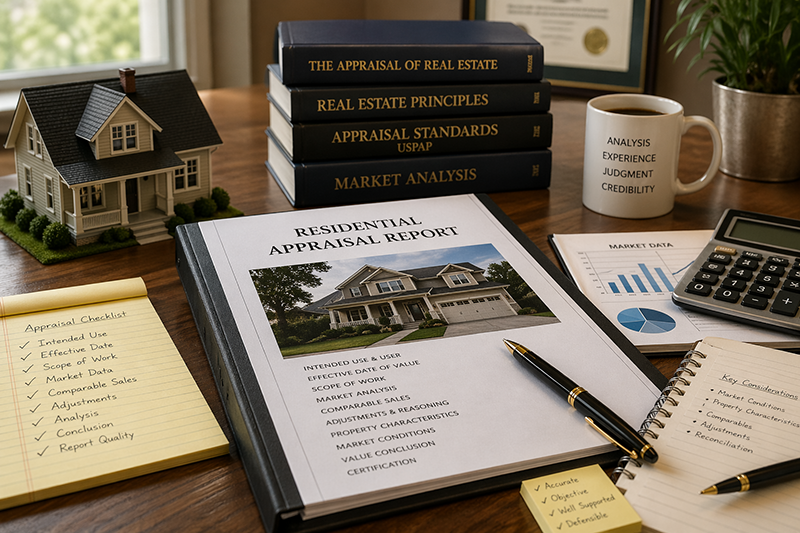
What Makes a Residential Appraisal Credible
Not all appraisal reports are built for the same level of scrutiny. A residential appraisal prepared for an internal planning decision may not require the same depth as one being relied on in court, submitted for tax purposes, or reviewed by multiple parties with competing interests.
A credible residential appraisal should include:
- A clearly identified intended use and intended user
- The correct effective date of the value
- A defined scope of work
- Market-supported comparable sale selection
- Appropriate adjustments with clear reasoning
- Analysis of current market conditions
- Discussion of relevant property characteristics
- A conclusion that is supported, not merely stated
- Reporting that is organized, understandable, and defensible
When the assignment involves legal or tax consequences, credibility depends not only on technical compliance but also on whether the report makes sense to the people relying on it. Attorneys, CPAs, trustees, executors, and property owners need an appraisal that is both analytically sound and clearly explained.
Residential Valuation Factors That Can Affect Value
A residential property’s value is influenced by much more than square footage or bedroom count. Two homes of similar size in the same city may vary significantly in value depending on their condition, utility, location, upgrades, lot characteristics, and market appeal.
Important residential valuation factors often include:
The Residential Appraisal Process
While every assignment is different, most residential appraisals follow a structured process designed to produce a supportable value conclusion.
1. Define the Assignment
The appraiser identifies the property, intended use, intended user, effective date, property rights appraised, and scope of work. This step is essential because it shapes the entire analysis.
2. Inspect the Property
For many residential assignments, the appraiser inspects the home and site to observe condition, quality, layout, improvements, and features that may affect value. The depth of inspection depends on the assignment conditions and scope of work.
Label
3. Research the Market
The appraiser analyzes market data relevant to the subject property, including recent comparable sales, listings, pending transactions, neighborhood trends, and broader market influences.
Label
4. Analyze Comparable Sales
The most relevant market evidence is selected and compared to the subject. Differences are analyzed and adjusted where necessary to develop an indication of value.
Label
5. Reconcile the Data
The appraiser weighs the evidence, explains the reasoning, and reaches a final opinion of value based on the quality and relevance of the available data.
6. Report the Conclusion
The final report communicates the assignment conditions, methodology, analysis, and value conclusion in a format appropriate for the intended use.
Residential Appraisals for Legal, Tax, and Fiduciary Matters
Many residential valuation assignments involve more than ordinary market pricing. They may be tied to legal deadlines, disputes among beneficiaries, IRS reporting, trust administration, or questions about historical value. In these matters, the appraisal needs to be more than technically competent. It must also be understandable and defensible in context.
That is especially important when the report may be reviewed by:
- Attorneys
- Courts
- Accountants and tax professionals
- Trustees and executors
- Heirs and beneficiaries
- Opposing counsel or competing experts
- Government agencies or review appraisers
A residential appraisal used in these settings should anticipate scrutiny. That means the market evidence should be relevant, the adjustments should be reasonable, and the logic should be clear from beginning to end.

Why Experience Matters in Residential Appraisal Assignments
Residential appraisal is not one-size-fits-all work. A straightforward tract home refinance appraisal and a retrospective valuation for an estate dispute are very different assignments. So is a divorce appraisal involving contested value, a luxury home with limited comparable sales, or a trust matter involving multiple residential interests.
Experience matters because the appraiser must be able to recognize complexity early, gather the right data, and produce a report that aligns with the assignment’s real purpose. That includes understanding when additional explanation is needed, when the market evidence is limited, and how to communicate valuation conclusions in a way that is useful to attorneys, fiduciaries, tax professionals, and property owners.
Collins & Associates provides residential appraisal services with an emphasis on analytical support, credibility, and practical clarity. Our assignments are developed with the understanding that many residential valuations are relied upon in important financial and legal decisions, not just routine transactions.
Residential Appraisal Coverage Across California
Collins & Associates provides residential appraisal services throughout Southern California and beyond, including assignments in:
-
Los Angeles County
-
Orange County
-
Riverside County
-
San Bernardino County
-
San Diego County
Geographic competence is a core part of residential valuation work. Local market behavior, buyer preferences, neighborhood boundaries, and comparable sale patterns all affect how residential property should be analyzed. A report should reflect not only the property itself, but also the realities of the market in which it competes.
Choosing the Right Residential Appraisal Service
Before ordering or relying on a residential appraisal, it helps to identify the real purpose of the assignment. The key questions are not just what the property is, but why the valuation is needed, who will rely on it, and what date and reporting requirements apply.
A residential appraisal engagement is often stronger when these issues are clarified at the outset:
- Is the appraisal needed for the current value or a retrospective date
- Is the intended use legal, tax-related, administrative, or advisory
- Will the report be shared with a court, CPA, trustee, or agency
- Does the property have features that make valuation more complex
- Is a standard form report appropriate, or is a more detailed narrative report needed
The answers to those questions help determine the proper scope of work and reporting approach. They also reduce the risk of ordering the wrong type of appraisal for the situation.
Understanding the Role of Data, Standards, and Professional Oversight in Residential Appraisals

Residential appraisals are developed using verified market data, professional analysis, and established regulatory standards that help support credibility and consistency across assignments. For clients involved in legal, tax, estate, or financial matters, understanding this process helps clarify why a professional appraisal carries more weight than informal estimates or automated valuation tools.
Most residential appraisal assignments begin with the analysis of verified sales data, including closed transactions, active listings, pending sales, and broader market trends. Appraisers also review public records, property history, legal descriptions, and other relevant documentation to help ensure the valuation reflects accurate and supportable information.
Professional standards also play a central role. Residential appraisals are developed in accordance with the Uniform Standards of Professional Appraisal Practice (USPAP), which establish ethical and performance requirements for valuation professionals. USPAP is maintained by the Appraisal Standards Board (ASB) under The Appraisal Foundation, while state appraiser regulatory agencies are responsible for licensing and enforcement within their jurisdictions. Federal oversight is provided through the Appraisal Subcommittee (ASC).
The appraisal process also relies on professional judgment. This includes evaluating property characteristics, analyzing comparable sales, identifying market trends, and applying appropriate adjustments based on differences in condition, location, utility, and overall marketability.
Unlike a real estate agent, whose role is typically focused on marketing and negotiating transactions, a property appraiser provides an independent and unbiased opinion of value. This distinction is especially important in assignments involving estates, trusts, litigation, tax matters, or other situations where neutrality and supportable analysis are critical.
For property owners, investors, fiduciaries, and legal professionals, understanding these layers of data verification, professional standards, and regulatory oversight helps explain why a properly developed residential appraisal is considered a more reliable and defensible valuation source for important financial or legal decisions.
Work With a Residential Appraiser Who Understands Complex Assignments
Residential appraisal assignments are not all the same. A straightforward refinance is very different from a valuation tied to an estate, trust, divorce, or legal dispute. In these situations, the appraisal must go beyond basic reporting. It must be clearly reasoned, well-supported, and appropriate for the specific purpose it serves.
At Collins & Associates, each residential appraisal is personally handled by David R. Collins, Certified General Appraiser (G.A.A., S.C.R.E.A.), bringing over 50 years of real estate valuation experience. His work is relied upon in assignments where accuracy, clarity, and credibility are essential.

Meet Your Residential Property Appraiser
David R. Collins, G.A.A., S.C.R.E.A.
Certified General Appraiser
David R. Collins is a Certified General Appraiser with decades of experience valuing a wide range of property types throughout Southern California. His background includes residential, commercial, and complex valuation assignments, allowing him to approach residential work with a broader analytical perspective than typical single-discipline appraisers.
Many residential assignments involve legal, tax, or fiduciary considerations where the appraisal must withstand scrutiny from attorneys, accountants, courts, or government agencies. In these cases, experience is not optional. It directly affects how the assignment is developed, supported, and communicated.
Trusted for Assignments That Require More Than a Basic Valuation
Collins & Associates provides residential appraisal services for clients who require more than a simple estimate of value. Assignments may involve:
- Estate and trust valuations
- Divorce and dispute-related appraisals
- IRS Date to Death Appraisals
- Gifting Appraisals
- IRS Estate Planning Appraisals
- Retrospective or historical valuations
- Private valuation needs for financial decision-making
These assignments are developed with careful market analysis, appropriate methodology, and clear reporting that aligns with the intended use of the appraisal.
Experience That Supports Clarity and Defensibility
Residential real estate often carries significant financial, legal, and family implications. An appraisal prepared for these matters should not only be technically sound, but also understandable and defensible in context.
With decades of experience and a focus on analytical support and practical clarity, Collins & Associates delivers residential appraisal reports designed to meet the expectations of clients, advisors, and reviewing parties alike.
Request a Residential Property Appraisal
Residential appraisal assignments often involve important financial, legal, and personal decisions. Whether you are dealing with an estate, trust, divorce, tax reporting, or a private valuation need, the appraisal should be clear, well-supported, and aligned with its intended purpose.
Collins & Associates provides residential property appraisals throughout Southern California, with each assignment personally handled by David R. Collins, G.A.A., S.C.R.E.A. Certified General Appraiser, bringing over 50 years of experience to complex valuation matters.
If you require a residential appraisal for lending, legal, tax, or advisory purposes, you may submit an appraisal request to begin the consultation process.
Initial discussions typically review the property type, purpose of the appraisal, effective date of value, and scope of the assignment.

Frequently Asked Questions
Schedule a Call Back with Dave Collins
Provide your contact information and Dave Collins will personally return your call to discuss your appraisal needs and timeline.
"*" indicates required fields